The Founder Operations OS: The 6 Systems That Run My Companies.
Why companies don’t scale. And why it’s rarely a talent problem.

Why companies don’t scale. And why it’s rarely a talent problem.
Most early-stage companies don’t break because of bad ideas.
They break because the founder becomes the bottleneck.
Not intentionally.
Not because they’re careless.
But because everything still routes through them.
Decisions.
Context.
Priorities
Follow-ups.
Exceptions.
At the beginning, this feels efficient.
Later, it becomes invisible drag.
This is where an operating system starts to matter.
Not a tool stack.
Not dashboards.
Not productivity hacks.
An operating system answers one question clearly:
How does work actually move through this company when things get busy?
Over time, I’ve learned that companies that scale quietly tend to have six systems in place early. Not perfect systems. Just explicit ones.
I’ll outline them here at a high level. Each deserves its own deep dive.
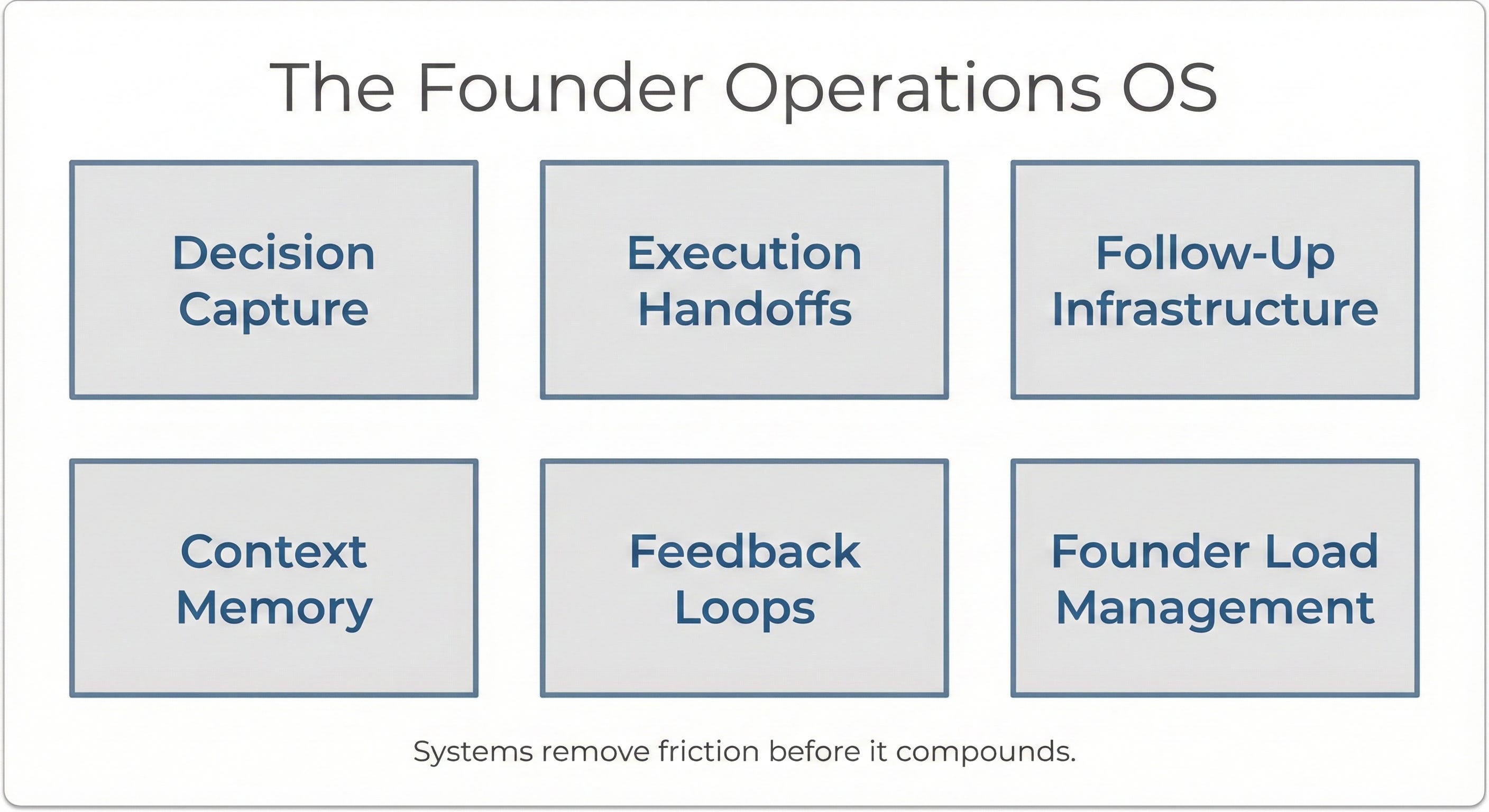
I’ll break each of these down in detail over the coming weeks.
1. Decision Capture
Most teams make decisions constantly.
Very few preserve them.
When decisions live in heads, Slack threads, or half-remembered meetings, the same conversations repeat. Confidence erodes. Momentum slows.
Example:
After leadership meetings, we capture the decision, the tradeoff we accepted, and what would trigger a revisit. Weeks later, no one asks “why did we do this?”—the context is already there.
Decisions become assets instead of arguments.
2. Execution Handoffs
Work rarely breaks at the idea stage.
It breaks at the handoff.
Who owns this next?
What does “done” mean?
What happens if it stalls?
If ownership isn’t explicit, momentum leaks quietly.
Example:
Every initiative ends with a single owner, a clear next action, and a time boundary. If it hasn’t moved by then, it surfaces automatically instead of dying silently.
This isn’t accountability theater.
It’s friction removal.
3. Follow-Up Infrastructure
Follow-ups feel small.
Individually, they are.
Collectively, they decide velocity.
When follow-ups rely on memory and discipline, they decay. When they’re systemized, progress becomes boring and reliable.
Example:
After every external call, the same summary and next steps go out within minutes. No one asks “who’s following up?” anymore. It’s assumed—and expected.
This is often the first place AI earns its keep.
4. Context Memory
Teams don’t fail because people forget facts.
They fail because context resets too often.
Why did we choose this path?
What assumptions were we making?
What changed?
Without context memory, teams either thrash or slow down.
Example:
When a project shifts direction, we log the assumption that broke and the new one replacing it. New hires and existing teammates can trace the “why” without reopening old debates.
Speed comes from preserved context, not urgency.
5. Feedback Loops
Healthy teams hear bad news early.
Unhealthy teams hear it late, filtered, or politely softened.
Feedback loops that work tend to sting a little.
Example:
We review missed deadlines and failed experiments in real time, focusing on what the system allowed -- not who dropped the ball. Patterns surface fast. Fixes follow.
If feedback doesn’t feel uncomfortable occasionally, it’s probably not honest.
6. Founder Load Management
This one is quiet -- and critical.
If the founder is still required for every decision, exception, and escalation, the company hasn’t scaled. It’s just grown louder.
The goal isn’t to remove the founder.
It’s to remove unnecessary dependency.
Example:
We explicitly document which decisions no longer need founder input. Over time, the founder’s role shifts from clearing queues to shaping systems.
That’s when leverage starts to show up.
The connective tissue
None of these systems need to be impressive.
They need to exist.
Early-stage success isn’t about brilliance.
It’s about judgment, timing, and removing friction before it compounds.
AI helps here not because it’s smart.
But because it’s consistent.
Consistency is what operating systems are for.
And scale is just consistency under pressure.
Next issue
Next week I’ll share:
I’ll break down how I implement these systems in practice, what I automate, what I don’t, and why.